



Ohio Treasurer Announces Bond Deal Savings of More Than $5.5 Million
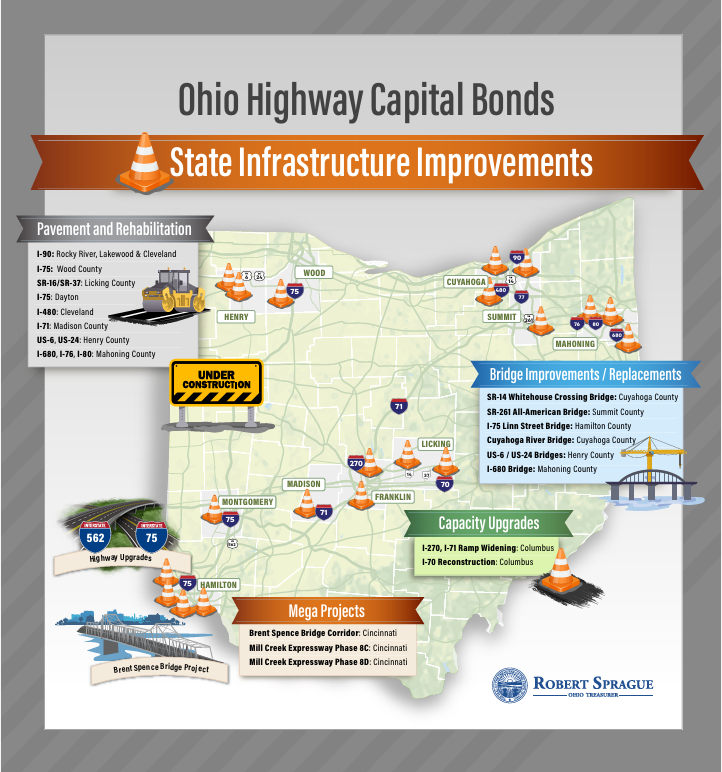
Download High Resolution Graphic
COLUMBUS – Last week, the Ohio Treasurer’s office closed a two-series, $325.625 million Highway Capital Improvement (HCAP) bond issuance, with $255.665 million funding major Department of Transportation projects (Series Z), and $69.960 million refunding outstanding HCAP bonds (Series AA). This refinancing transaction allowed the state to achieve over $5.5 million in present value savings on debt service.
These HCAP bonds will finance construction on major ODOT projects, including interstate replacement and rehabilitation, bridge replacements, and more. The construction will include the Brent Spence Bridge Corridor Project and a new companion bridge in Cincinnati/Hamilton County, the third and fourth phases of the Mill Creek Expressway project to widen the expressway for additional lanes and bridge rehabilitation, and the reconstruction and widening of Interstate 75 and State Route 562 in southern Ohio, among many others. For a full list of projects financed through these bonds, click here.
“We’re happy to help advance construction and infrastructure improvements while generating significant savings through strategic bond issuance,” said Ohio Treasurer Robert Sprague. “By leveraging market conditions, our team was able to achieve immediate savings as well as decrease risk for the State’s debt portfolio.
Debt service on the bonds is paid from Highway User Receipts, with a secondary pledge of the full faith and credit of the State. The Highway User Receipts include motor fuel taxes, fuel use taxes, registration and license fees, and permit revenues. The HCAP bonds are rated AAA from four national rating agencies, which is the highest rating possible.
Investors in the State of Ohio receive priority in orders placed for Ohio bonds, and those individual investors purchased over $22 million of the HCAP Bonds, which amounts to almost 7% of the total par. Municipal bonds issued by the Ohio Treasurer’s office are generally tax exempt, which means investors do not have to pay federal, and sometimes state, taxes on their interest income. Buying tax exempt bonds can be advantageous to bondholders depending on their income tax brackets.
###